Family accounting links your Personal space with your partner’s. Each of you keeps your own accounts, categories and reports, and your partner sees only what you share: a transaction you mark as Family or an account you mark as Joint. This article covers the setup: inviting, what the partner sees, joint accounts, shared categories and ending access. Family access is a Pro feature in a Personal space: the person who invites needs Pro, and the partner’s access is free. It is available on the web, Android and iOS. Business spaces don’t have family access; they share a space through members and roles instead.

How family accounting works

A family in finerd is two Personal spaces linked together. Nothing is merged: your partner’s accounts, balances and history stay in their space, and yours stay in yours. One space can be in one family at a time. Linking changes nothing by itself. Your transactions stay private until you share them in one of two ways: Both of you also get an account in the Family accounts group that stands for the other person. finerd uses it as the other side of shared money: when you transfer to your partner, choose this account as the destination so the transfer isn’t counted as an expense (Transfers from a joint account). Categories, merchants and tags belong to each space. A new family starts with Share categories & tags turned on, so a shared transaction keeps the same category for both of you. Turn it off if you’d rather file shared transactions your own way; see Share categories and tags.

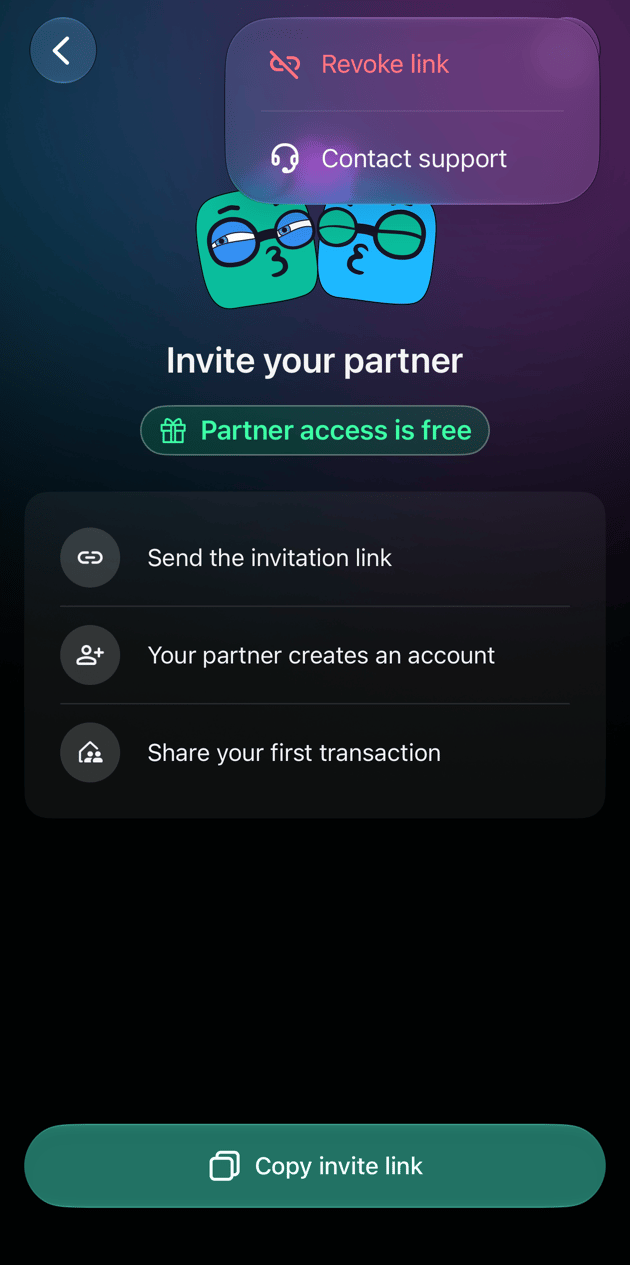
Invite your partner

You need Pro in your Personal space. Your partner needs a finerd account of their own, or they create one from your link. The link works for 3 days, and one invitation can be active at a time.
  1. Open More at the bottom of the sidebar and select Family access.
  2. Select How it works and read the slides with Next. The last Next opens Invite your partner.
  3. Select Copy invite link and send the link to your partner, or let them scan the QR code with their phone. Link copied confirms the copy.
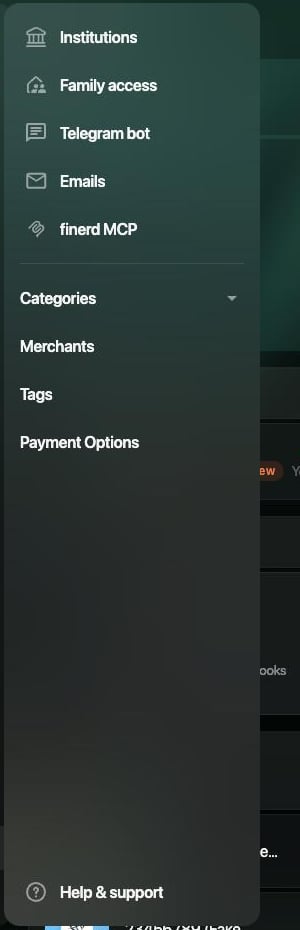
The More menu in the finerd web app with Institutions, Family access, Telegram bot, Emails and finerd MCP

More → Family access opens the invitation.
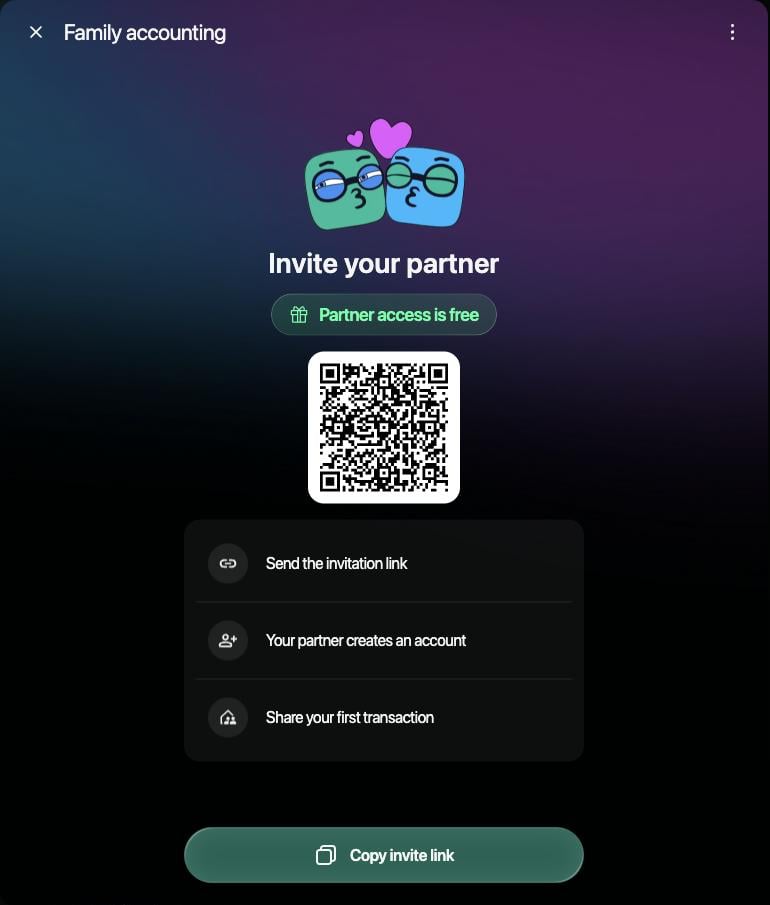
Family accounting modal on the web: Invite your partner, Partner access is free, a QR code, three steps and the Copy invite link button

Invite your partner: QR code, the three steps and Copy invite link.
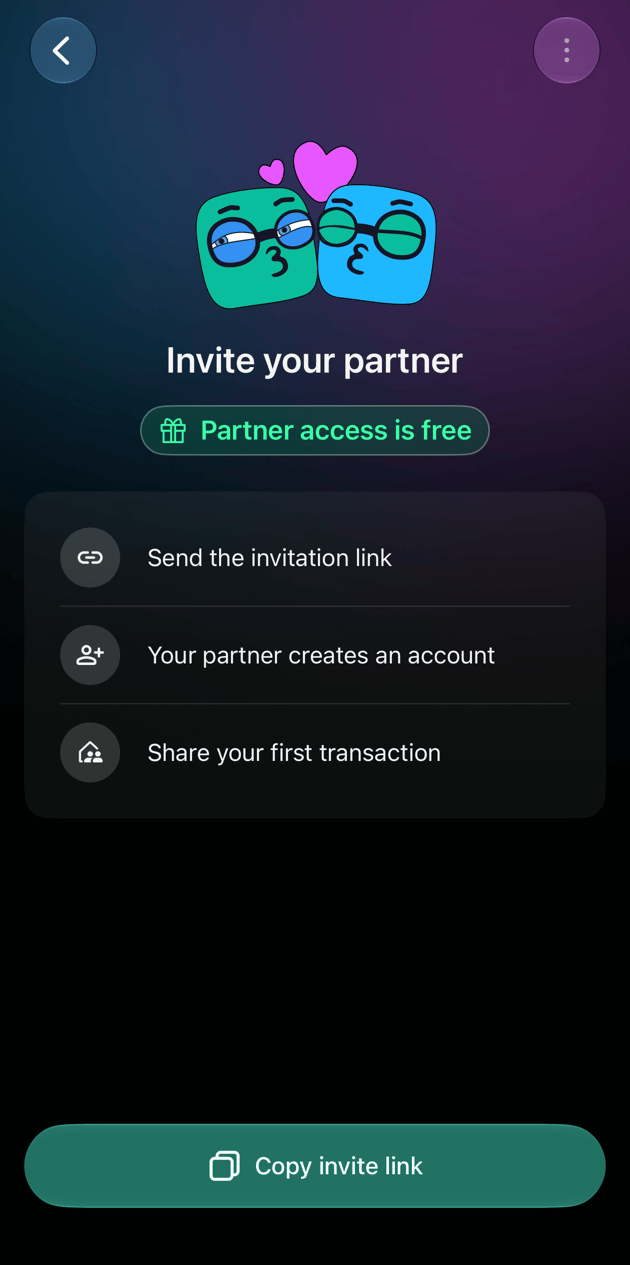
To cancel a link you’ve already sent, open Family access again, select ⋮ in the header, then Revoke link and confirm. The next time you open Family access, finerd generates a new link.
On the web and iOS, your partner’s account in your space is named Partner. You can rename it later like any account.

Accept the invitation

Your partner opens the link on any device. If they don’t have finerd yet, the page offers Get started to create an account first; the invitation is kept until they finish signing up. If they are signed in, they see You’ve been invited to manage family finances with your email and Your access is free, and they select Accept invite. The invitation always joins their Personal space, so it can’t be accepted while a Business space is open.

You've been invited to manage family finances with lucas+1@finerd.ai, Your access is free, and the Accept invite button on iOS

The invitation on iOS: Accept invite.

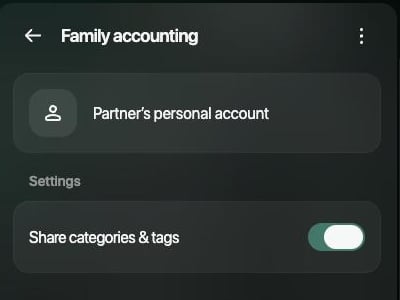
After accepting, finerd shows the same slides and, on the web, offers to connect the Telegram bot, which can mark transactions as Family from chat. Both of you then see Family access with the partner’s account (Partner’s personal account on the web, Partner’s account on iOS, Family member on Android).
Family accounting drawer on the web: Partner's personal account, Settings with Share categories & tags on

Family accounting on the web after the partner joined.
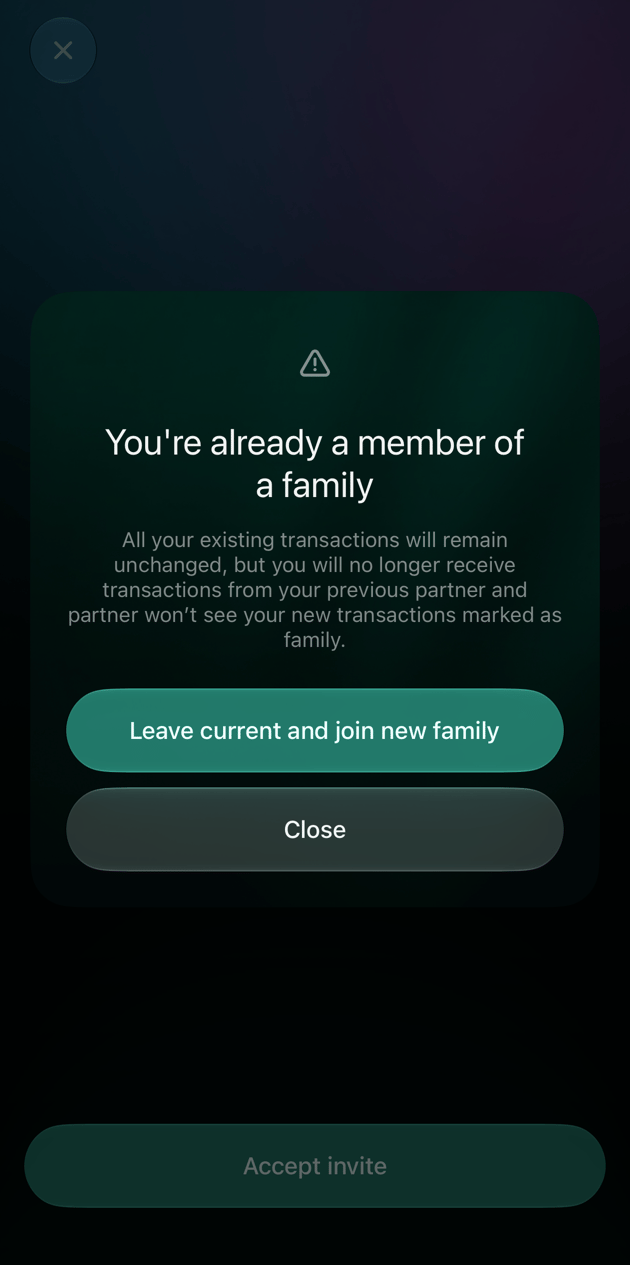
If your partner is already in another family, finerd says You’re already a member of a family. They need to leave that family first: open Family access, select ⋮, then Leave family, and open your link again. Leaving keeps their past family transactions but stops new ones from the previous partner.
You're already a member of a family dialog on iOS with Leave current and join new family and Close

A partner who is already in a family has to leave it before joining yours.

If the two of you were a family before and reconnect, finerd tells you it is Reconnecting with partner and brings back the family transactions you shared earlier.

What your partner sees

Until you share something, your partner sees nothing from your space: no accounts, balances, transactions, categories or reports. Each thing you share appears in their space as its own record:
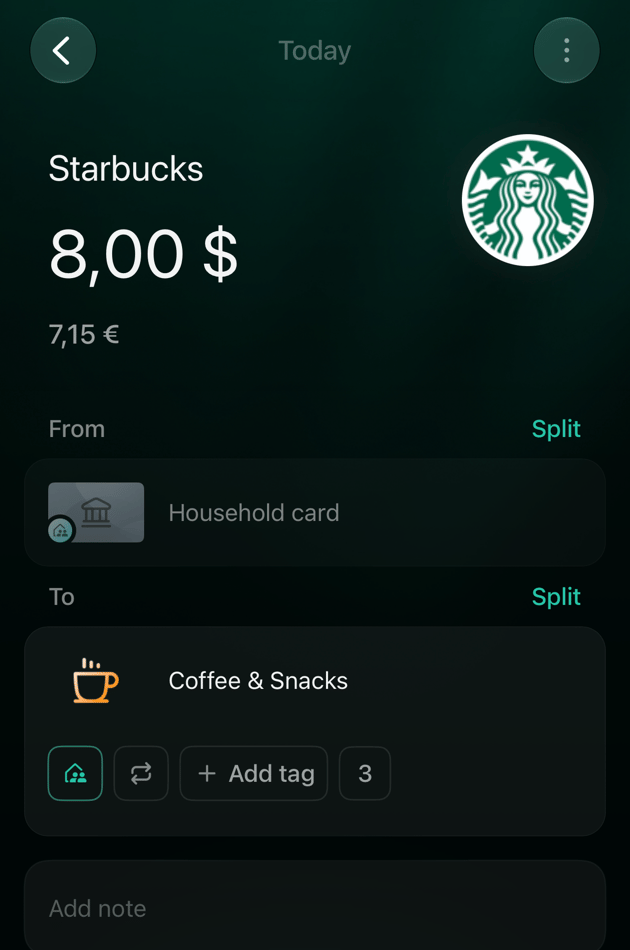
The partner's copy of a shared transaction on iOS: Starbucks $8 from Household card to Coffee & Snacks with the Family chip selected

The partner's side: a shared Starbucks expense from the joint Household card.
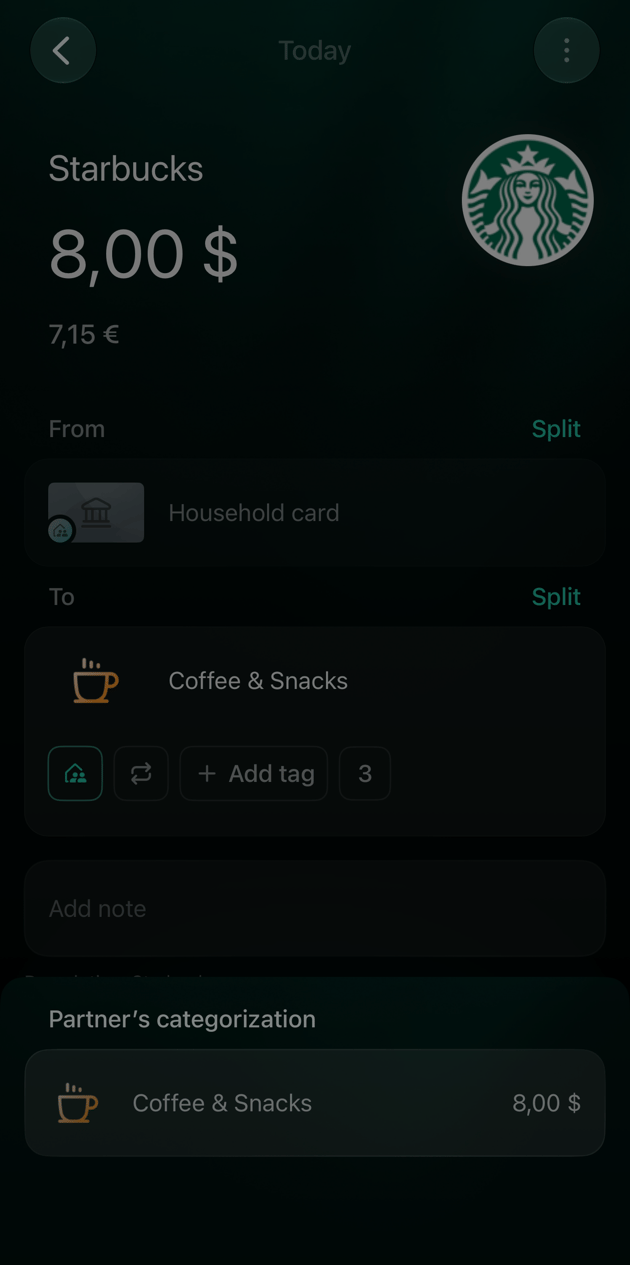
In your own space, shared transactions are filtered with Personal & Family → Family (Me) or Family (Partner), reports can be grouped By partner, and the web has a Family spending report with Personal, Family (Me) and Family (Partner) columns. A transaction your partner paid has Partner’s categorization in its ⋮ menu, so you can see how they filed it without changing your own category.
Partner's categorization sheet on iOS showing Coffee & Snacks 8,00 $ under the Starbucks transaction

Partner's categorization: how your partner filed a shared transaction.
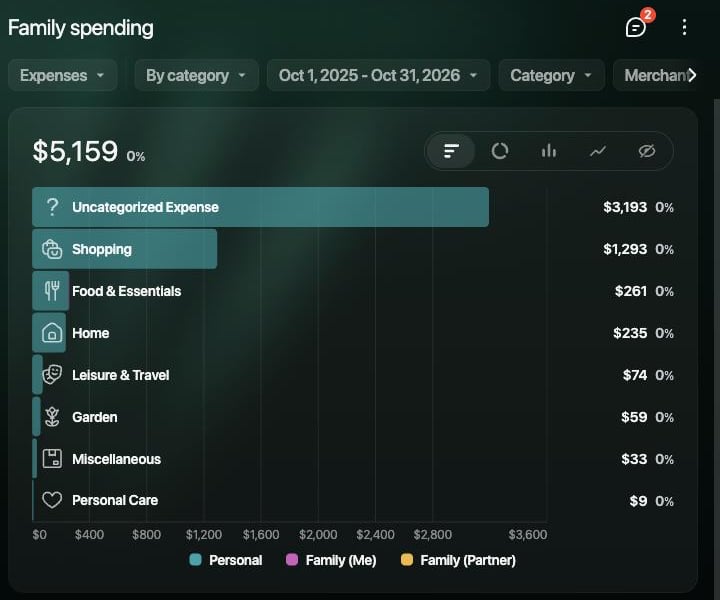
Family spending report on the web with a bar chart by category and a table with Personal, Family (Me) and Family (Partner) columns

Family spending on the web: shared expenses next to personal ones.

Share a whole account as joint

Mark an account as joint when your partner should see its balance and every transaction, for example a shared card or the household savings. The bank doesn’t need to know the account as joint: finerd treats any of your accounts the same way. What you can’t share this way: a Debt account, Money on the way, the partner account itself, and a debt account linked with another person. Everything else, including bank, cash, investment, property and loan accounts, can be joint.
  1. Open Accounts and the account you want to share.
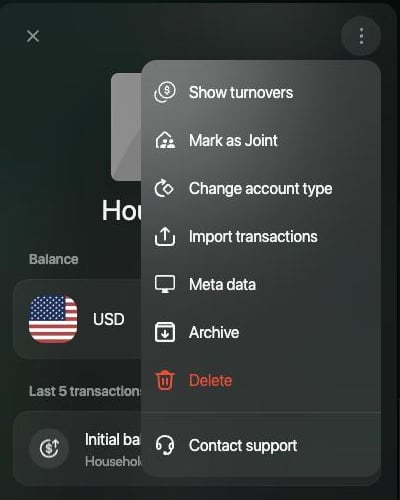
  2. Select ⋮, then Mark as Joint.
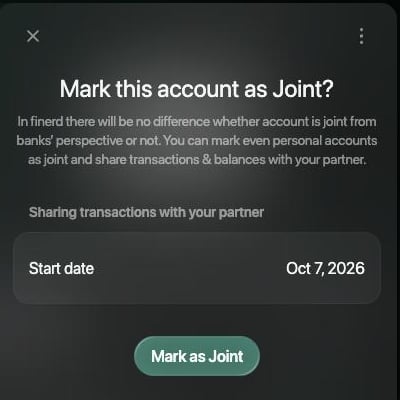
  3. Under Sharing transactions with your partner, set the Start date. Today is selected by default.
  4. Select Mark as Joint.
The ⋮ menu of an account on the web: Show turnovers, Mark as Joint, Change account type, Import transactions, Meta data, Archive, Delete, Contact support

⋮ on an account: Mark as Joint.

Mark this account as Joint? drawer on the web with Sharing transactions with your partner, Start date Oct 7, 2026 and the Mark as Joint button

Mark this account as Joint? with the start date.
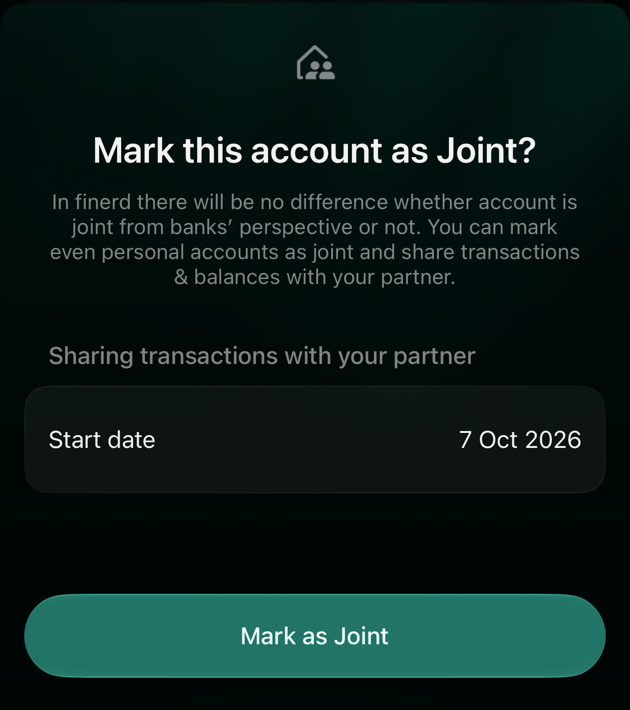
From the start date, finerd marks every transaction on the account as Family, sends them to your partner and shares the balance. Transactions before the start date stay private. Your partner gets the account in their Accounts list with a family badge, and Family access lists it under Joint accounts. On a bank-connected account only you record transactions; on a manual joint account both of you can. A new expense from a joint account already carries the Family mark when you add it. To keep a single transaction private, see Make a joint-account transaction private.
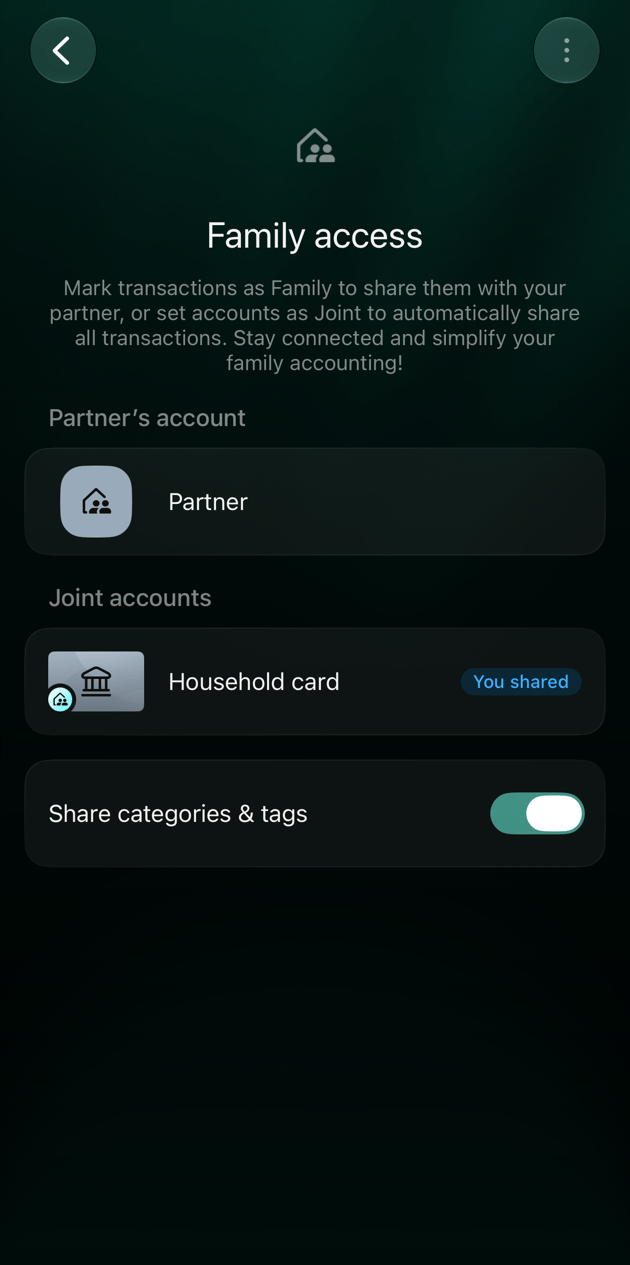
Family access on iOS: Partner's account Partner, Joint accounts Household card with You shared, Share categories & tags on

Family access with a joint account.

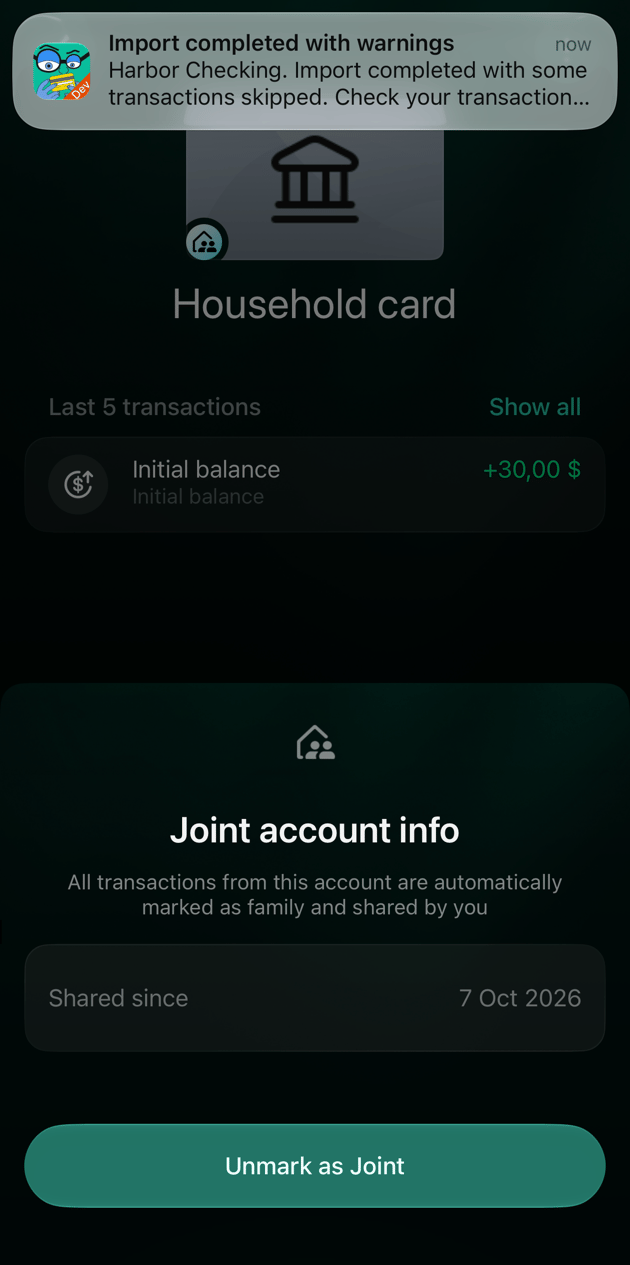
To check the date or stop sharing, open the account’s ⋮ menu and select Joint account info. Start date (iOS and Android: Shared since) shows when sharing began. Unmark as Joint stops new transactions from being shared; the transactions your partner already received stay in their space. On a bank-connected joint account only the person who shared it can unmark it; if you only see the account because your partner shared it, ask them.
Joint account info sheet on iOS with Shared since 7 Oct 2026 and the Unmark as Joint button

Joint account info on iOS: Shared since and Unmark as Joint.
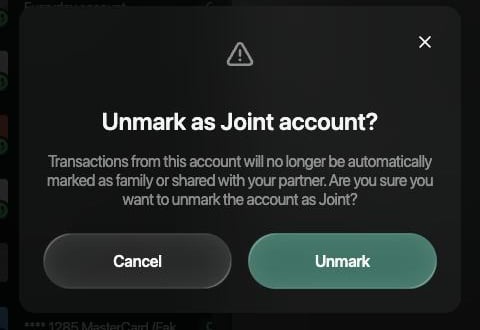
Unmark as Joint account? dialog on the web: Transactions from this account will no longer be automatically marked as family or shared with your partner, with Cancel and Unmark

Joint account info and the Unmark as Joint confirmation on the web.

Share categories and tags

Share categories & tags in Family access (web and iOS; Android doesn’t have the switch yet) decides whether a shared transaction keeps one category and one set of tags in both spaces. It is on for a new family: a transaction you share arrives in your partner’s space with your category, and a category or tag either of you edits changes for both. Turn it off when you want to file shared transactions your own way: select the switch and confirm Turn off sharing. finerd warns that your reports and budgets may then differ from your partner’s. From then on, each of you categorizes shared transactions independently, and Partner’s categorization shows the other side’s choice. Turning it back on replaces your partner’s categorization of family transactions with yours; finerd asks you to confirm with Share anyway.
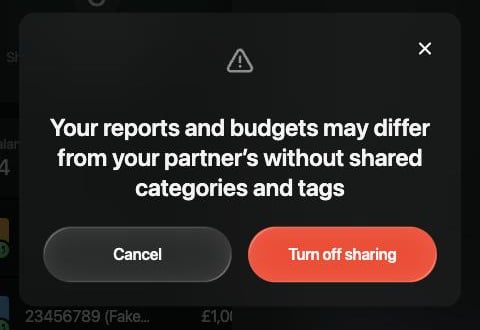
Dialog on the web: Your reports and budgets may differ from your partner's without shared categories and tags, with Cancel and Turn off sharing

Turning off shared categories and tags on the web.

End shared access

  • A link you sent by mistake: revoke it as described in Invite your partner. A link that was already accepted can’t be revoked.
  • The whole family: either partner can leave. Open Family access, select ⋮ in the header, then Leave family and confirm Leave. There is no way to remove a partner from your side: leaving is the only option, and it works the same for both of you.
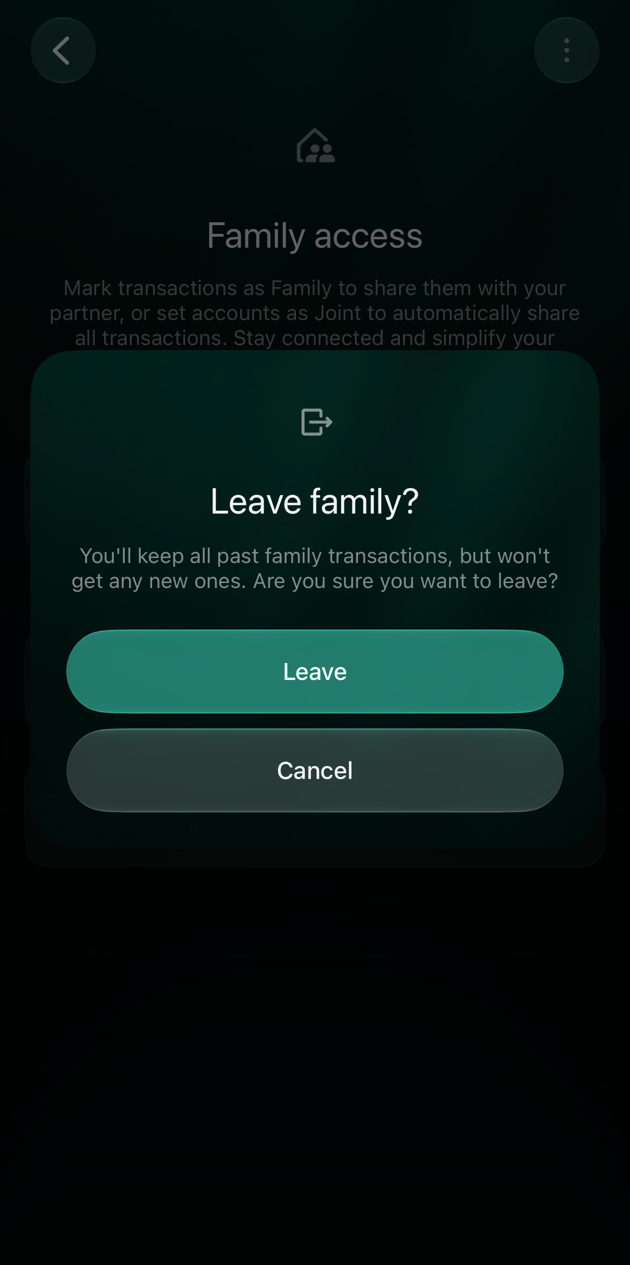
Leave family? dialog on iOS: You'll keep all past family transactions, but won't get any new ones. Are you sure you want to leave? with Leave and Cancel

Leave family? on iOS.

After you leave:
  • Both of you keep every family transaction you already have; the copies become ordinary transactions you can edit or delete. No new transactions are shared.
  • Joint accounts are unmarked. The copy in your partner’s space stays as a normal account.
  • The partner account is archived in both spaces and can’t be unarchived.
  • Shared categories and tags stop syncing.
If the Pro subscription that covers the family ends, finerd leaves the family automatically after 7 days. You can invite the same person again later: finerd recognizes the previous partner and restores the family transactions you had shared.