Plan monthly income and expenses by category in finerd, then follow planned, actual and remaining amounts, spending outside the plan and past months.
A budget in finerd is a monthly plan: you set how much you expect to spend and earn, split it by category, and finerd compares the plan with your real transactions as the month goes on. One budget covers one calendar month and carries over to the next months until you change it.Budgets are free and work on the web, Android and iOS, in personal spaces. All amounts are in your space’s primary currency.
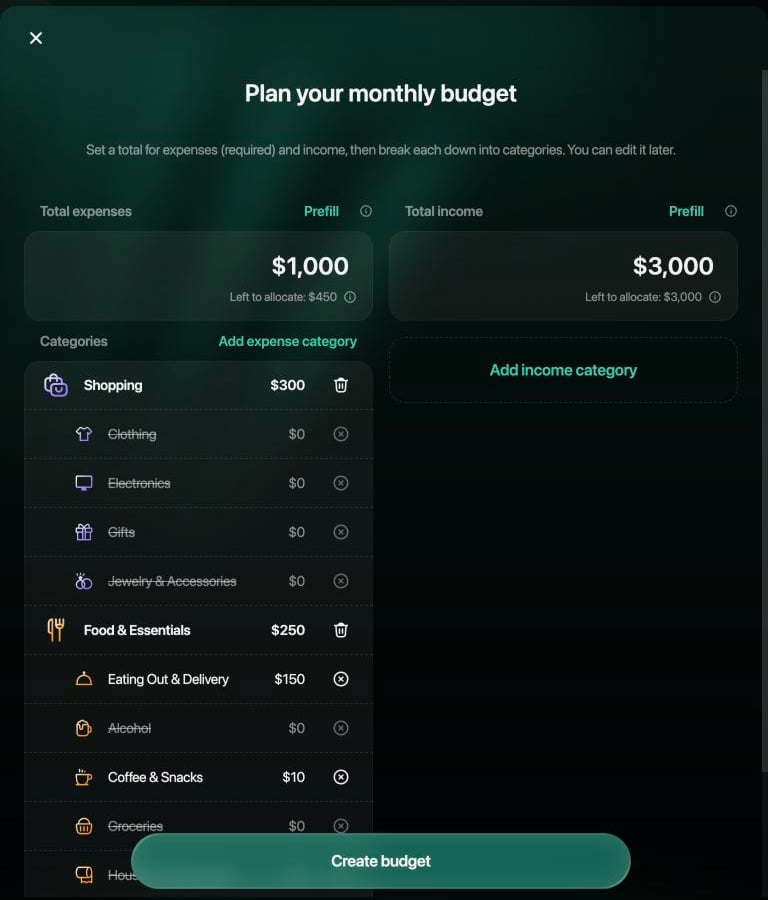
A budget has two sides: Expenses, which is required, and Income, which you can leave empty. Each side has a total, and you can split the total into categories. The part of the total you don’t give to any category goes to Other (see below).Example: expenses of 1,000amonth,with∗∗Shopping∗∗at300 and Food & Essentials at 250,andincomeof3,000.
Web
Android
iOS
In the sidebar, select Budget, then Create your first budget.
Under Total expenses, select the amount and enter the total for the month, for example $1,000. The chart above the calculator shows your spending in each of the last 6 months.
Select Add expense category, choose a category, enter its amount and select Continue. Repeat for each category you want to plan. Left to allocate shows how much of the total is still free.
To plan income, do the same under Total income.
Select Create budget.
To start from your own history instead, select Prefill above a total. finerd fills in the total and the categories with suggested amounts based on your spending or income in recent months, replacing what you entered on that side. Change any amount before you create the budget.
Expenses of $1,000 with two categories, and income of $3,000.
To see this month’s budget on Dashboard, add the Budget widget from the dashboard’s ⋮ menu. It’s titled Expense budget, or Income budget if you set its Type to Income.
Open Reports and tap Budget, then Create budget.
Under Expenses, tap Total and enter the total for the month. The chart shows your spending in recent months. Tap Save.
Tap Add expense category, choose a category, enter its amount and tap Save. Repeat for each category you want to plan.
To plan income, tap Add income and enter the total. Add income categories with Add income category.
Tap Save.
You can also open the budget from the Budget widget on Dashboard, if you’ve added it.
Open Reports and tap Budgets, then Create budget.
finerd opens Set total expenses. Enter the total for the month and tap Save. The chart shows your spending in recent months.
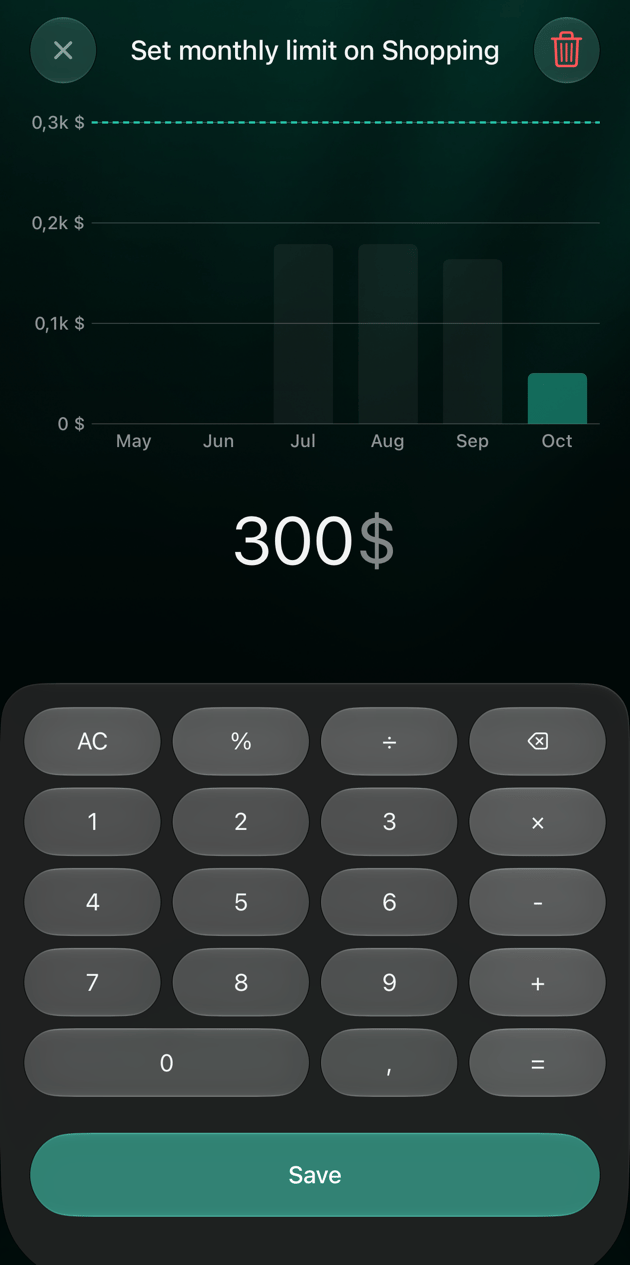
Tap Add expense category, choose a category, enter its amount on Set monthly limit on and tap Save. Repeat for each category you want to plan.
To plan income, tap Add income and enter the total. Add income categories with Add income category.
Tap Create budget.
The Budget widget on Dashboard shows how much you’ve spent of the plan this month; tap it to open the budget.
The Budget widget on Dashboard.
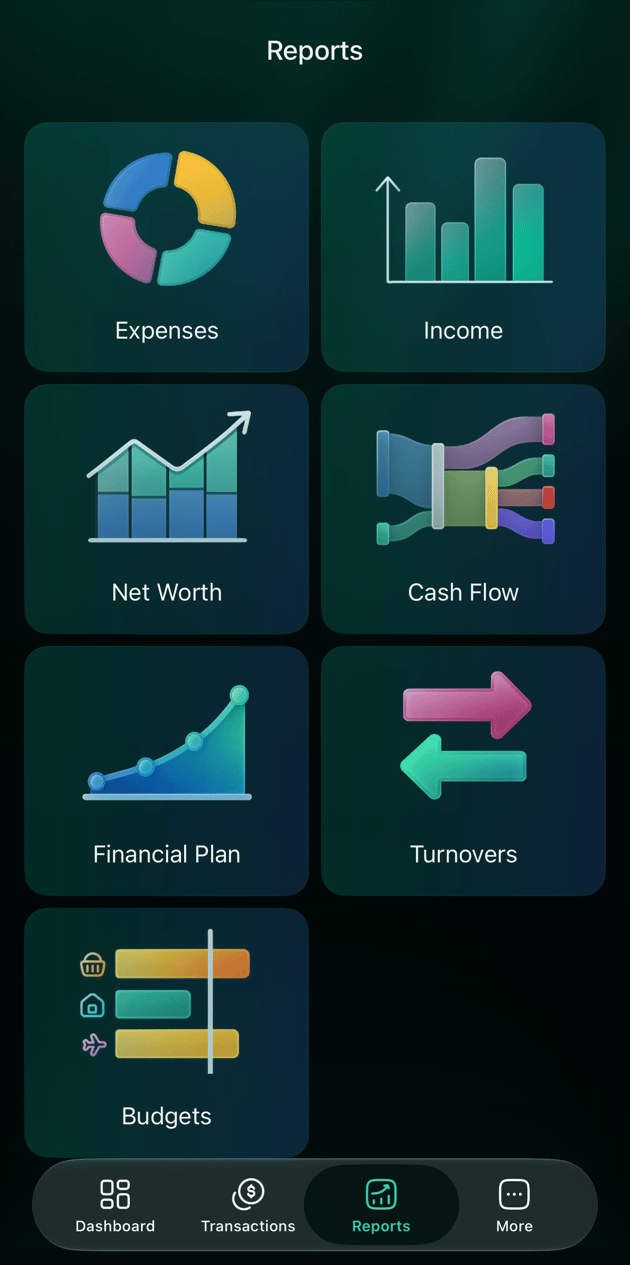
Budgets is one of the tiles in Reports.
Set the amount for a category; the chart shows the last months.
You create a budget for the current month or a later one. Past months can’t be planned or changed.
Categories in finerd have two levels, such as Food & Essentials with Groceries and Coffee & Snacks under it, and you can plan either level:
Choose a parent category to plan the whole group with one amount.
Choose a subcategory to plan it separately. finerd adds its parent too, and the parent’s amount can’t be lower than its planned subcategories together.
In the example, Eating Out & Delivery150 and **Coffee & Snacks** 10 are planned inside Food & Essentials250.Theremaining90 of the group covers its other subcategories, such as Groceries.
Web
Android
iOS
When you choose a category, its subcategories appear under it at 0.Leavethemat0 if you don’t plan them separately: they aren’t saved and their spending counts in the parent. To remove a category, select the bin next to it; for a subcategory, the cross clears its amount.
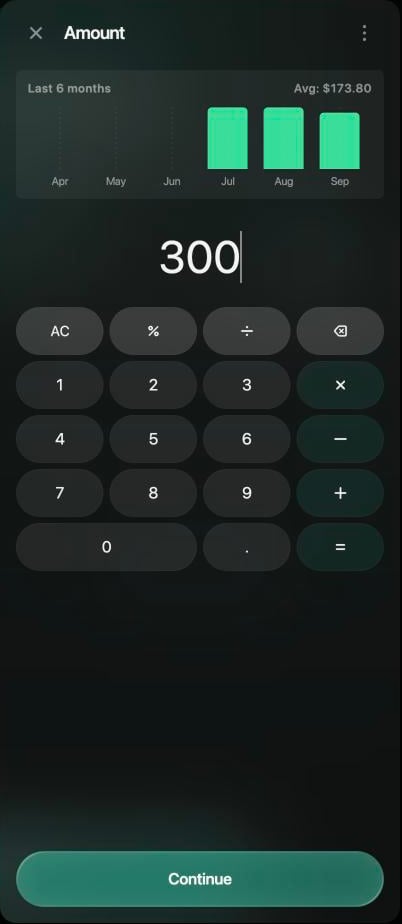
The amount drawer for a category, with its last 6 months.
Picking a parent category adds its subcategories at 0; categories you leave at 0 aren’t saved. To remove a category, tap the bin next to it. Removing a parent removes its subcategories too.
Picking a parent category adds its subcategories at 0; categories you leave at 0 aren’t saved. To remove a category, tap it and then the bin at the top of the amount screen. Removing a parent removes its subcategories too.
Amounts in other currencies are converted to your primary currency.
The progress bar shows how much of the plan you’ve used. In the current month, a thin line marks how far through the month you are:
Green: spending is within the plan and on pace for the month.
Orange: you’re spending faster than the month is passing.
Red: you’ve reached or passed the planned amount.
For income it works the other way round: orange means you’ve received less than expected so far, and green at 100% means you’ve reached the plan.Select or tap a row to open Transactions with that category and month already filtered; a parent category includes its subcategories.
Web
Android
iOS
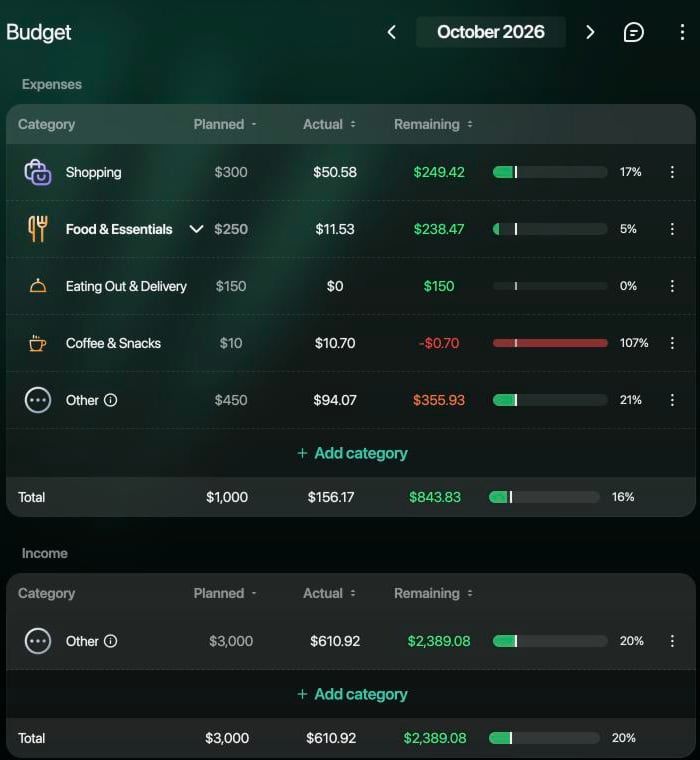
Expenses and Income are tables with Planned, Actual and Remaining columns; select a column header to sort by it. Select the arrow next to a parent category to show its planned subcategories. Summary shows the total for expenses: the percentage used, Planned, Actual and Remaining.
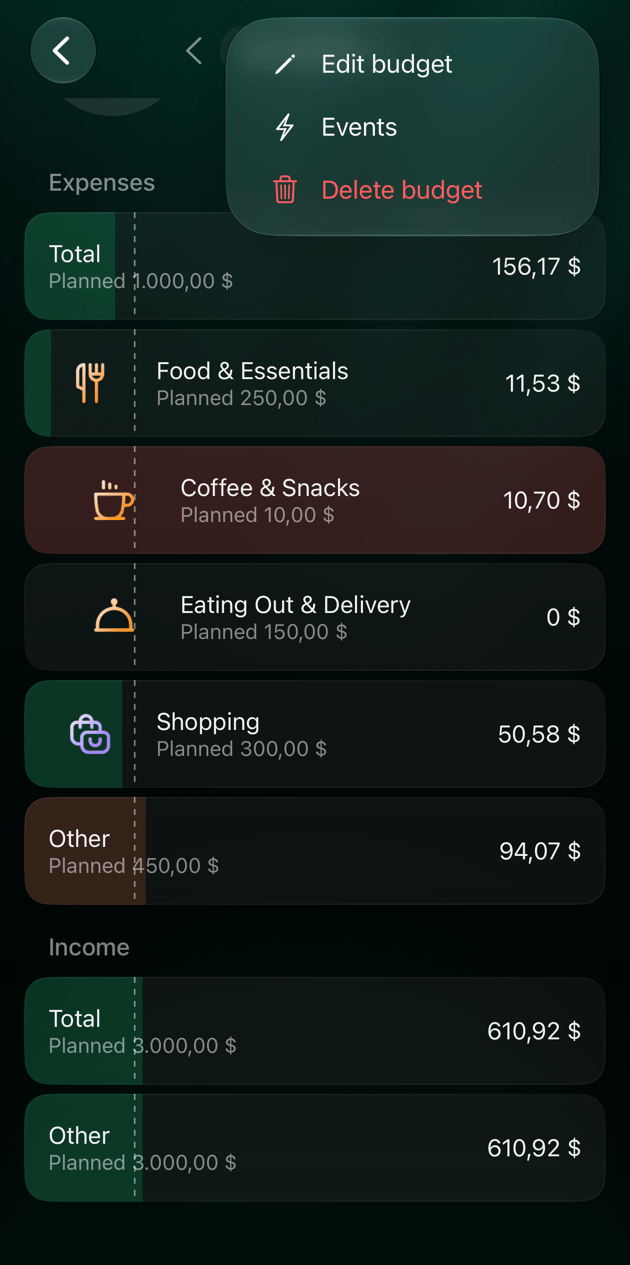
Coffee & Snacks is over its plan by $0.70.
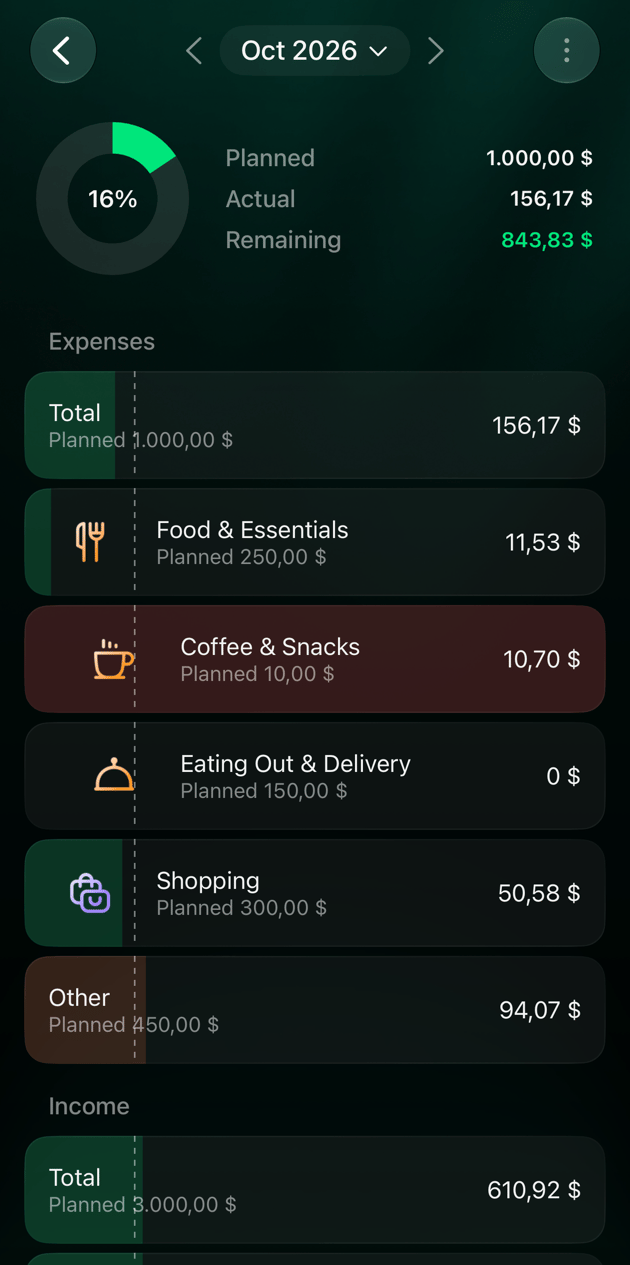
The top of the budget shows the expense total: the percentage used, Planned, Actual and Remaining. Each row shows the actual amount on the right and the plan under the name, such as of $300; the remaining amount appears only in the summary.
The top of the budget shows the expense total: the percentage used, Planned, Actual and Remaining. Each row shows the actual amount on the right and Planned under the name; the remaining amount appears only in the summary.
The row turns red when the category is over its plan.
Other collects everything you didn’t plan by category, so the budget still adds up to the total:
Planned for Other is the part of the total you didn’t give to any category: 1,000−300 − 250=450 in the example.
Actual for Other is what you spent in every category that isn’t in the budget, and isn’t a subcategory of a planned one, for example Leisure & Travel or Garden.
Select or tap Other to see those transactions. If a category in Other keeps growing, add it to the budget with its own amount: its amount then comes out of Other, and the total stays the same until the categories need more than it has.Other is shown only when it has a planned or actual amount. Income has its own Other for income categories you didn’t plan.
Use the arrows next to the month, or select the month itself, to move between months.
Next months: your budget carries over to the following months with the same plan, so you don’t create it again each month. If you change a future month, the change applies from that month on; earlier months keep their plan.
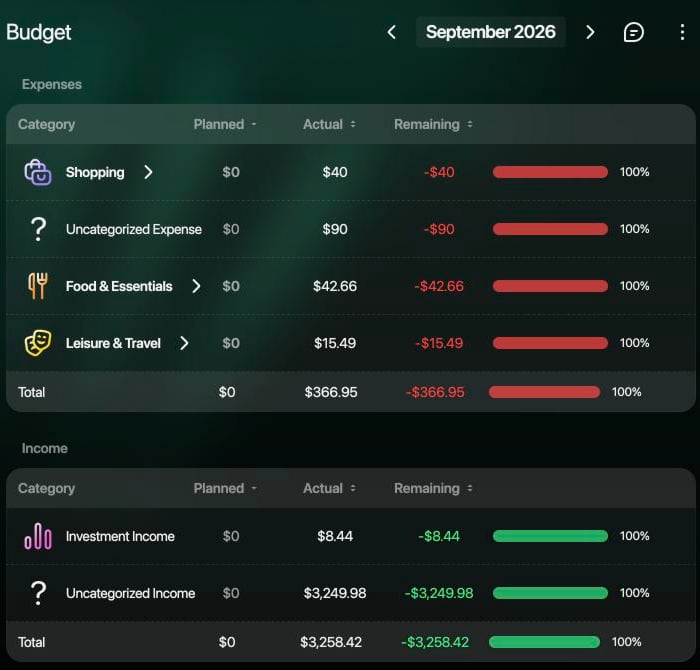
Past months: you can open them to compare the plan with what happened, but you can’t edit them. A past month that had no budget shows only what you spent and received, with nothing planned.
To decide on an amount, look at the chart in the amount editor: it shows the category’s spending in each of the last 6 months.
A past month without a budget shows only the actual amounts.
You can change the budget of the current month or a later one. Past months can’t be changed.
Web
Android
iOS
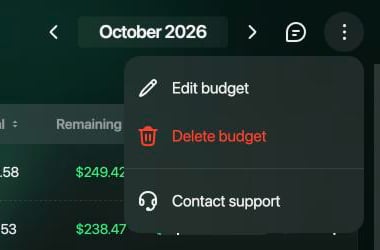
Change the whole plan: select ⋮ at the top of the page, then Edit budget. Change the amounts and select Save.
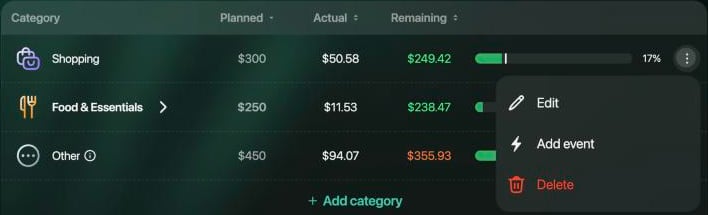
Change one category: select ⋮ in its row, then Edit, enter the new amount and select Continue.
Add a category: select Add category under the table.
Remove a category: select ⋮ in its row, then Delete. Its amount goes back to Other.
Delete the budget: select ⋮ at the top of the page, then Delete budget.
Each category row has its own menu.
Edit or delete the budget from the menu at the top.
Tap ⋮ at the top of the budget:
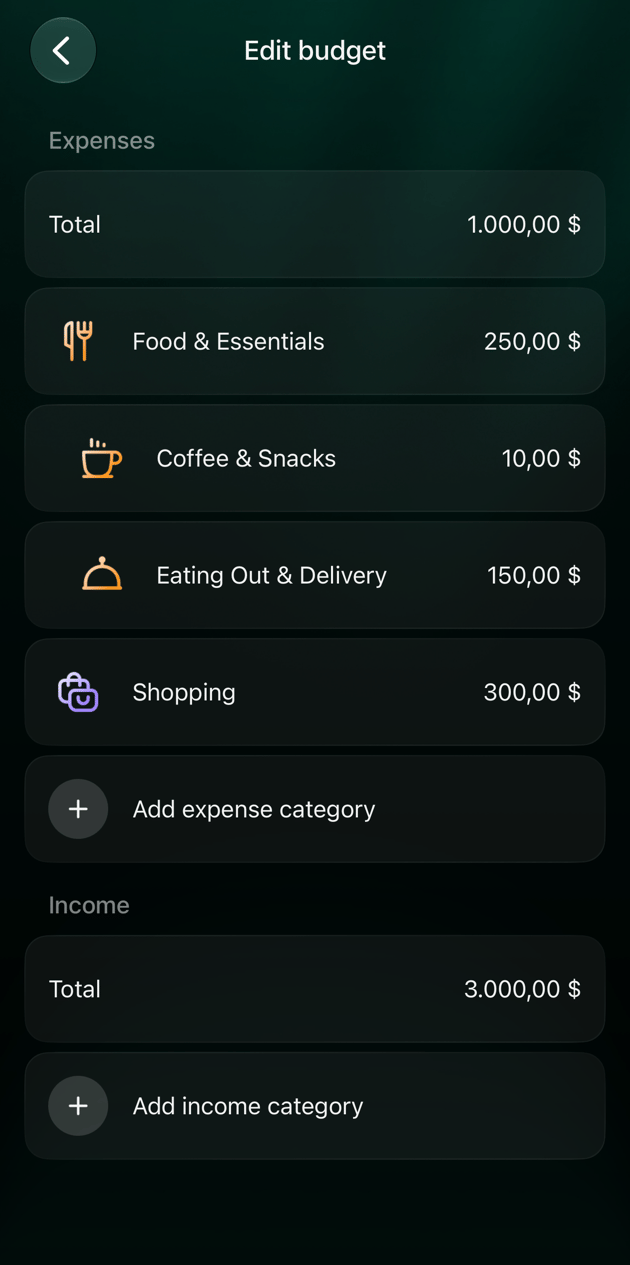
Edit budget opens the plan: tap an amount to change it, Add expense category to add one, or the bin to remove one. Tap Save.
Delete budget asks Delete this budget and all future months?
Tap ⋮ at the top of the budget:
Edit budget opens the plan: tap a row to change its amount, Add expense category to add one, or a row and then the bin to remove it. Tap Save.
Delete budget asks Delete this budget and all future months?
The budget menu.
Edit budget: tap a row to change its amount.
Deleting a budget removes it from the month you’re viewing and from every month after it. Earlier months keep their budgets.To handle a one-off expense, move budget between categories for one month or resolve a budget alert, see Adjust your budget when plans change.