
How events work
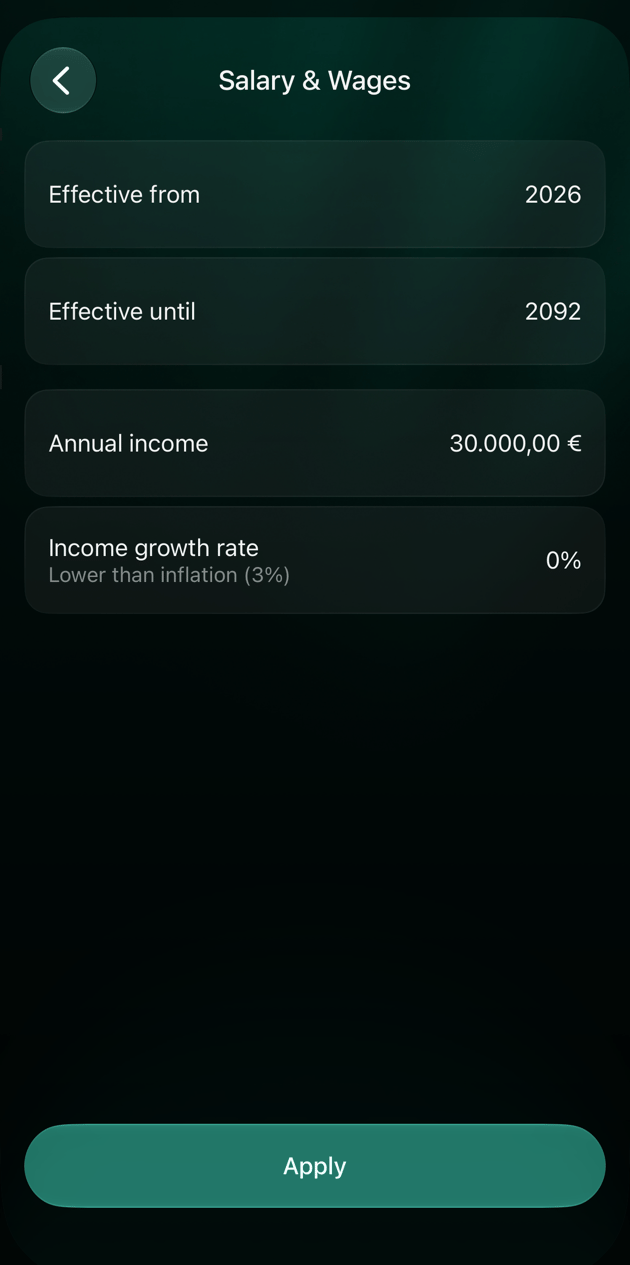
An event has a name, a date and one or more items. Each item is an asset, a loan, an income category or an expense category, with an amount and the years it applies, from Effective from to Effective until.- An income or expense item replaces that category’s amount in the plan for those years. For example, a Salary & Wages item of 60,000 USD from 2028 means your salary is 60,000 USD a year from then on.
- An asset or loan item adds its amount to the balance the account has reached in the plan by then.
Add an event
- Web
- iOS
- Open Reports > Financial plan and select the pencil next to Scenario:.
- Under Future events, select Add event.
- Enter a name in Event name, such as New car.
- Select Event type and choose the kind of event. The type sets the event’s icon and color; every type has the same fields.
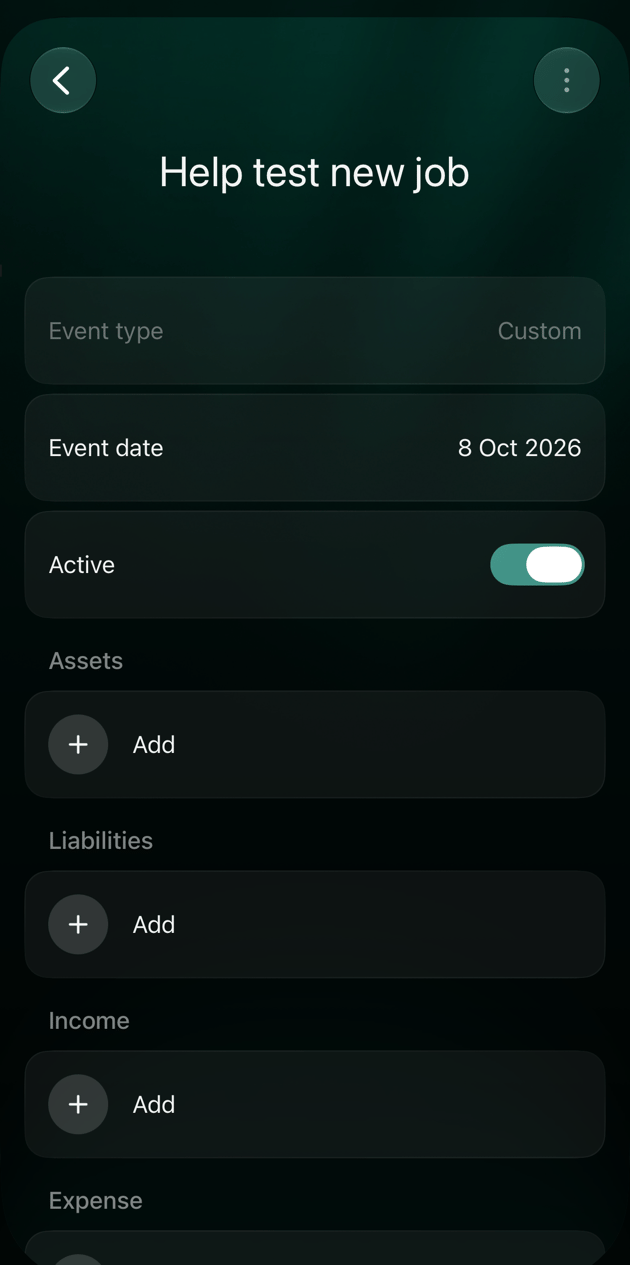
- Select Event date.
- Under Assets, Liabilities, Income or Expenses, select Add and choose an account or category. Enter its amount, rate and years, then select Save. Repeat for each item.
- Select Save in the event, then Save in the scenario.
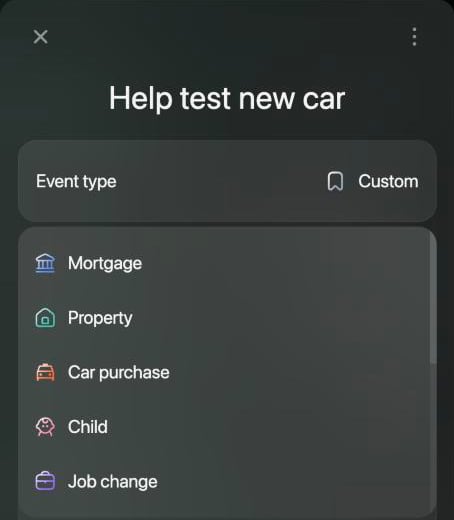
Event types on the web.
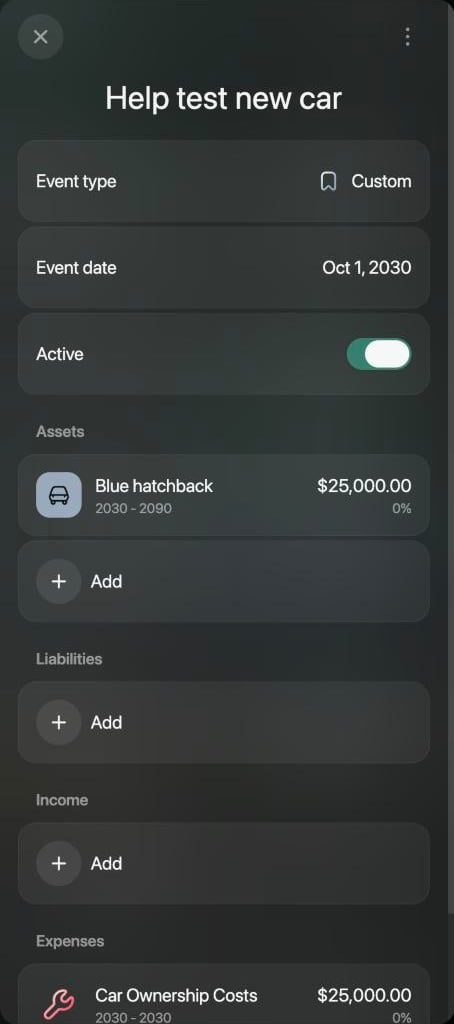
A car bought in October 2030.
Plan a big purchase
A purchase usually has two sides: what you’ll own and how you’ll pay for it.- Add an event dated when you plan to buy, such as New car in October 2030.
- Under Assets, add the account for what you’re buying and enter its value, such as 25,000 USD for a car. Set how it gains or loses value each year; a car usually loses value.
- Pay for it in one of two ways:
- With savings: under Expenses, add a category such as Car Ownership Costs, enter the price and set Effective until to the same year, so it counts once. In a Month or Quarter scenario the amount repeats in every month or quarter of that year, so enter a twelfth or a quarter of the price.
- With a loan: under Liabilities, add the loan and enter the amount you’ll borrow, with its Interest rate and Payoff. See Take out a loan.
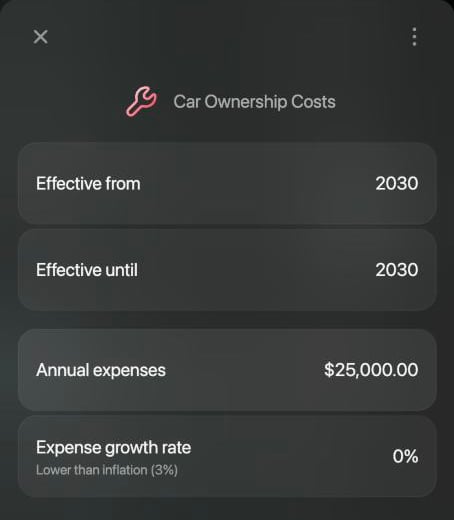
Paid with savings: the car's price counts as an expense in 2030 only.
Change your income or spending
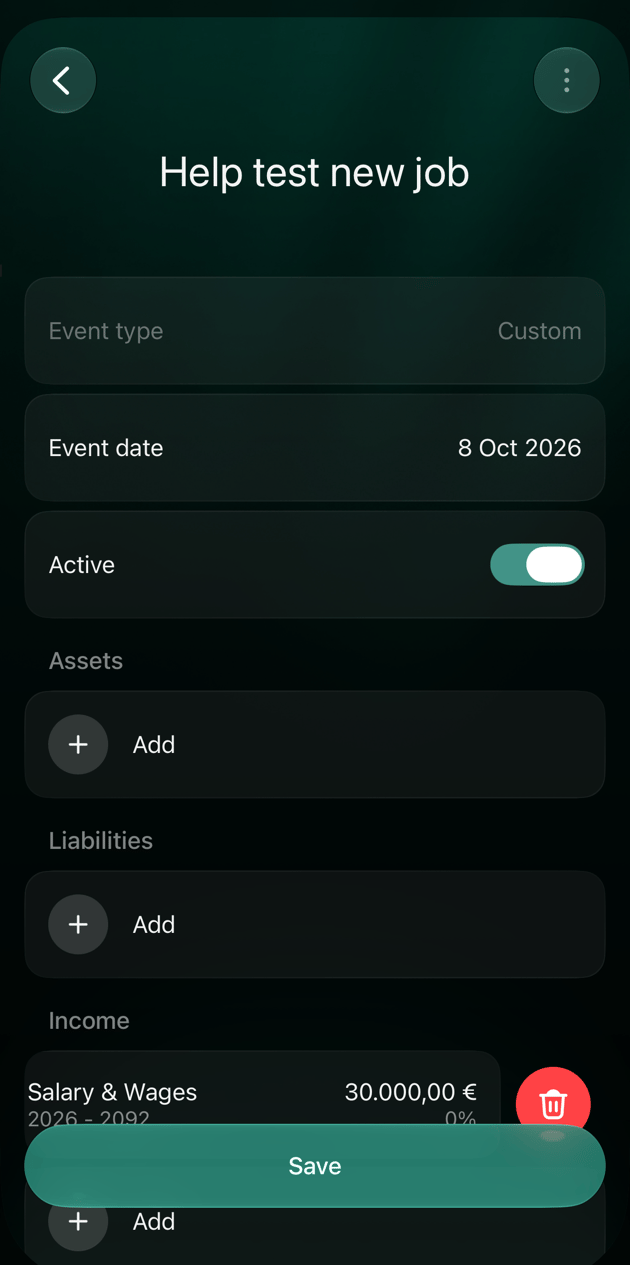
Use an event when an amount changes from a given year:- A new job or a raise: under Income, add Salary & Wages with the new yearly amount from the year it starts.
- A child: under Expenses, add a category such as Kids with what you expect to spend a year, from the birth year until the year support ends.
- A move, travel or a sabbatical: add the expenses that change, and the income you won’t have, for the years it lasts.
Take out a loan
Under Liabilities, add the loan account and enter the amount you’ll borrow. As in the scenario, a loan item needs an Interest rate and a Payoff: Amount with the yearly payment in Annual pay, or Period (years) with the number of years in Pay years. How the loan itself is tracked is described in Track a loan or mortgage.Plan your retirement income
Every scenario has a Retirement event. It starts in the year you reach your retirement age, and it lists each of your income categories at 0: from then on, your salary and other income stop. Add what you’ll live on after you retire:- Open the Retirement event.
- Under Income, open Pension, or another category such as Investment Income, and enter the yearly amount in today’s money.
- Save the event and the scenario.
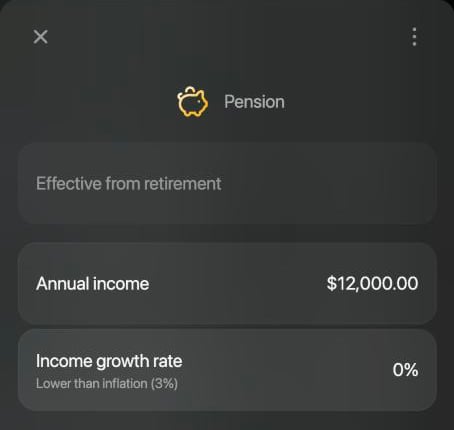
A pension of 12,000 USD a year from retirement.
See events on the chart
On the web, each event with a date shows its icon above that year in the chart. Select the icon to highlight the years the event covers, counted as Year 1, Year 2 and so on. When you point at a year, the details list the events in it.Turn off, change or delete an event
To see the plan without an event but keep it for later, open it and turn off Active. The event stays in the list, dimmed.- Web
- iOS
- To change an event, select it in Future events.
- To delete an event, point at it in Future events and select the trash can icon that appears. finerd removes it straight away, without asking; it’s gone for good once you save the scenario, so close the scenario without saving to keep it.
- You can’t remove a single item from an event on the web. To drop one, delete the event and add it again without it.
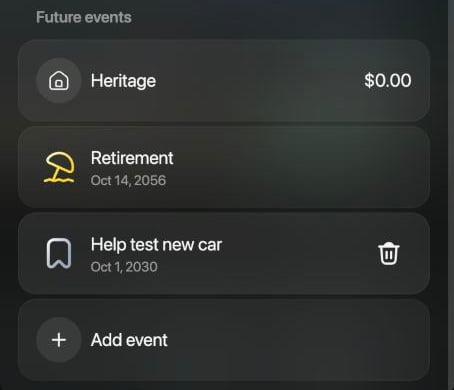
The trash can appears when you point at an event.
Related articles
- Build a financial plan
- Compare and update scenarios: copy a scenario to test an event before you add it to your main plan.
- Track property
- Track a loan or mortgage